
Nothing Happened
A True Account of Two Horses, One Oak Tree, and a Disk Harrow's Brief Career in Aviation

Amos and Gideon
There are two kinds of chaos in the world.
The first kind arrives loudly, waving flags and making speeches about how important it is.
The second kind is attached to two perfectly respectable Belgian draft horses named Amos and Gideon.
The second kind is considerably more effective.
The Amish frolic had been proceeding according to the ancient and sacred traditions of rural moving days. These traditions consisted primarily of lifting heavy objects, placing them in wagons, lifting them off wagons, eating pie, discussing weather, and occasionally standing around looking thoughtfully at things while someone else did the lifting.
By ten o’clock, three barns’ worth of relatives, neighbors, cousins, cousins’ cousins, and people who had simply wandered in because they recognized a buggy in the driveway had arrived to help a young family move into their new home.
Everything was going smoothly.
This should have been the first warning.
The second warning was Amos.
Amos was not technically a difficult horse. He was merely a horse who occasionally entertained independent thoughts. Most horses possess approximately three:
Hay.
More hay.
Why is there not hay right now?
Amos occasionally developed a fourth thought.
This was widely regarded as a design flaw.
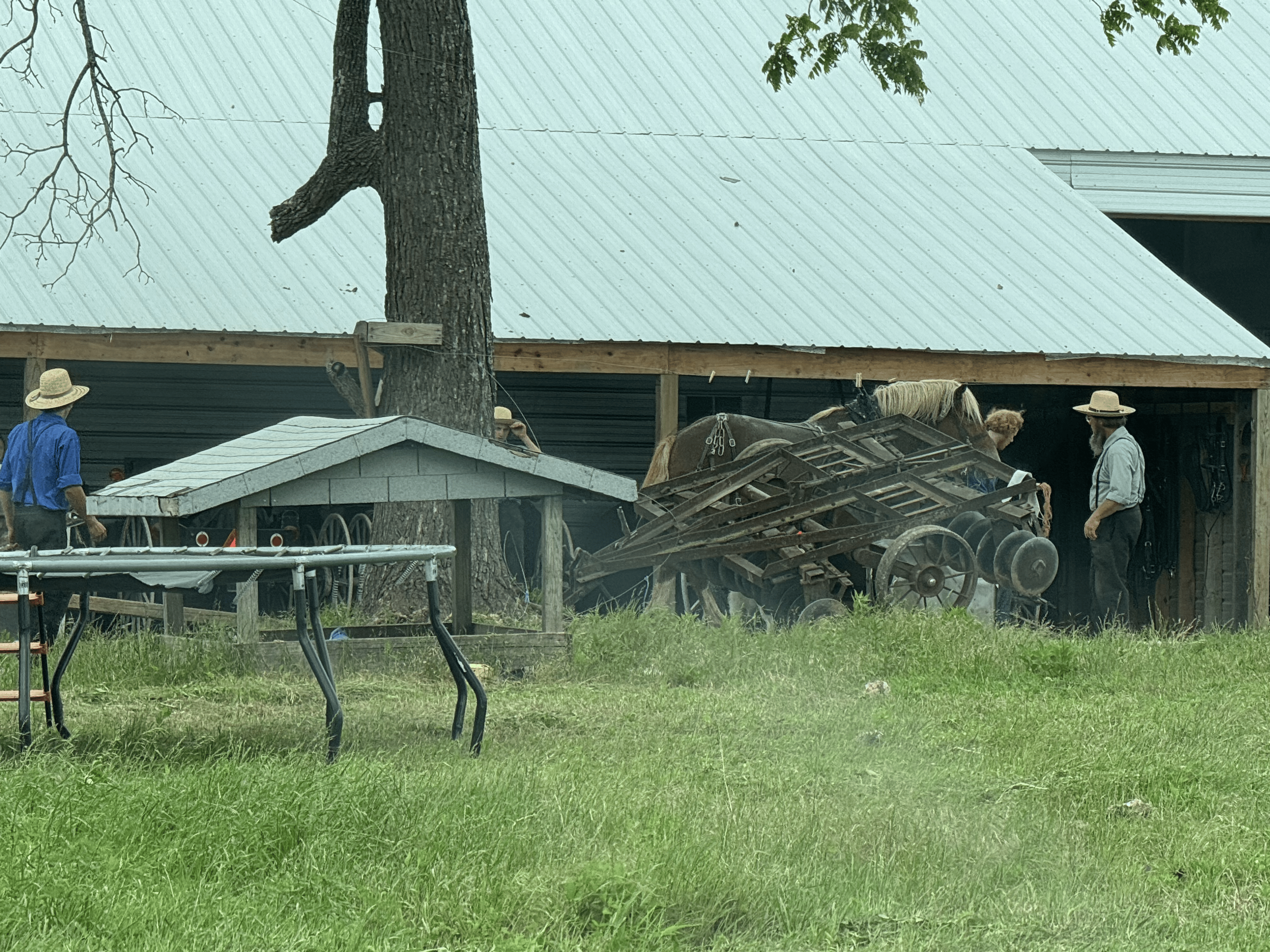
The disk harrow sat peacefully beneath a large oak tree near the edge of the field. It weighed approximately the same as a small moon and had all the graceful elegance of medieval siege equipment — if medieval siege equipment had also been specifically designed to destroy topsoil.
Nearby, several English drivers stood together in a loose cluster. They had been hired to transport Amish families the hundred and twenty-five miles to the frolic, and they had spent the morning doing what city people do at events like this: watching, marveling, and quietly wondering if they were supposed to be doing something.
Not completely city people. Some had lawns.
But they were the sort of people who believed danger came with warning labels, customer support numbers, and at minimum, a strongly worded pamphlet.
One of them was watching Amos and Gideon with mild concern.
“Are they supposed to be looking at each other like that?”
An Amish farmer glanced over.
“They’re horses.”
This appeared to answer everything.
Unfortunately, it answered nothing.
The exact cause of the incident remains disputed.
Some claim a tarp moved.
Others blame a squirrel.
One witness suggested Amos simply remembered an appointment he’d forgotten.
Whatever the cause, Amos decided the current arrangement of reality was unacceptable. He communicated this view to Gideon.
Gideon, being a horse and therefore deeply committed to validating poor decisions made by friends, agreed immediately and with enthusiasm.
The team lunged.
Harness chains snapped taut.
The disk harrow moved.
Now, a disk harrow is not designed for speed. Neither, technically, is a grand piano. But attach enough horse to either one, and remarkable things become possible.
The machine shot across the field with all the dignity of a runaway cathedral.
Steel disks bounced.
Chains rattled like something escaping from somewhere it had been locked for good reason.
Dust erupted in a biblical column.
People shouted.
Chickens achieved low earth orbit.
The English drivers froze. Every single one of them. Perfectly still, like a photograph of people about to run.
The disk harrow accelerated.
The horses accelerated.
Physics, which until that moment had been having a perfectly pleasant morning, suddenly became extremely interested.
“Should somebody do something?” one of the drivers yelled.
The Amish men were already moving.
Not running. Amish farmers do not run unless absolutely necessary, and sometimes not even then.
They moved quickly in the way glaciers move quickly—with purpose, with inevitability, and with the calm confidence of men who understood that panic had never once in the history of the world actually helped.
Across the field, Amos and Gideon reached a velocity previously considered theoretical for animals of their size.
The oak tree waited.
Trees are very good at waiting. It is one of the primary reasons they tend to win arguments with machinery.
The collision arrived with a sound somewhere between thunder, an explosion, and a blacksmith falling down a very long staircase while holding other blacksmiths.
The tree stayed where it was.
The disk harrow reconsidered several of its most fundamental life choices.
One wheel departed the scene independently, apparently having decided to pursue other opportunities. A chain vanished into a bush. Something large and metallic described a long arc through the air and landed in the pond with a sound that sent every frog in a ten-yard radius into early retirement.
Silence followed.
The specific silence that occurs when reality briefly pauses to make sure everyone is finished.
A chicken descended from the sky.
The horses stood blinking, wearing the expression of animals who had fully committed to a plan and were only now beginning to assess the plan.
The tree looked smug.
One of the English drivers spoke first.
“Good Lord.”
An elderly Amish bishop surveyed the wreckage.
“Hm.”
This was not, in Amish culture, a casual sound.
Depending on tone and context, “Hm” could mean anything from “That fence needs fixing” to “I am quietly reconsidering my opinion of you.”
This particular “hm” appeared to mean:
Well. That happened.
The crowd slowly moved closer. Everyone checked everyone else. No injuries. No broken bones. No disasters beyond the obvious and quite spectacular disaster directly in front of them.
The young family whose house was being filled looked relieved.
The horses appeared pleased with themselves. Genuinely pleased. The way you are pleased when a thing you did turned out more interesting than you expected.
The bishop nodded once.
“Let’s eat lunch.”
One of the drivers stared.
“Lunch?”
“Well,” said a farmer, gesturing at the wreckage with the philosophical air of a man who had seen worse, “the disk isn’t going anywhere now.”
This was difficult to argue with.
Within twenty minutes, three hundred sandwiches had appeared from somewhere.
Pies materialized from unknown dimensions.
Coffee flowed.
Children resumed their previous activities without comment because children understand intuitively that dramatic events are for adults to be upset about and that they personally have things to do.
The wrecked harrow remained embedded in the tree like a modern art installation entitled Consequences of Horses.
The English drivers sat together at a folding table, staring into the middle distance with the thousand-yard look usually reserved for combat veterans and people who have attempted to assemble flat-pack furniture without the instructions.
“What just happened?” one finally asked.
An Amish grandfather considered this with the unhurried seriousness the question deserved.
“The horses ran away.”
“Yes, but—everyone seems strangely calm about it.”
The old man took a bite of pie. Chewed. Considered.
“Nothin’ happened.”
The driver pointed at the machine wrapped around the oak like a monument to ambition.
“That happened.”
“Machine can be fixed.” He looked at the tree. “Tree’s fine.”
Another bite of pie.
The driver looked around. The move had resumed. Furniture was being carried. Someone was discussing tomato plants with evident expertise. A child was chasing another child for reasons that had nothing to do with the recent incident.
The world had apparently decided not to end after all and had moved on accordingly.
He sat with this for a while.
And then he understood.
The Amish had a superpower. Not horse handling — clearly. Not barn raising, though that was genuinely impressive. Not pie production, though the pie was extraordinary.
No.
Their superpower was the ability to tell the difference between a catastrophe and an inconvenience.
A catastrophe is when people get hurt.
An inconvenience is when a disk harrow attempts to briefly occupy the same physical space as an oak tree.
One of these things requires grief. The other requires lunch.
The driver reflected that he had spent most of his adult life treating inconveniences like catastrophes, and that this had probably not served him especially well.
He accepted a second slice of pie.
By sunset, the house was full.
The wagons were loaded.
The horses were calm, which was the least they could be.
The tree was standing exactly where it had always stood, as it fully intended to continue doing.
The disk harrow had begun a promising second career as scrap metal.
And the story had already become legend—the way stories do when they are both completely true and slightly unbelievable.
Because every Amish frolic eventually produces a story. Most involve pies. Some involve weather. A rare and fortunate few involve runaway horses and agricultural equipment achieving temporary flight.
Years from now, people would still tell it.
Not because anyone was hurt. Nobody was.
Not because anything important was lost. Nothing truly was.
But because for one glorious, improbable minute, Amos and Gideon had looked at a perfectly ordinary moving day and decided, with complete conviction, that it simply wasn’t exciting enough.
And in the end—against all reasonable probability—they had been absolutely right.
Author’s Note
This happened today.
I was one of the English drivers standing at that folding table, holding my pie, trying to understand why nobody was panicking. I watched Amos and Gideon make their decision. I watched the harrow hit the tree. I watched three hundred people collectively shrug and reach for the sandwiches.
I drove home and wrote it down before I could forget any of it—which is to say, before the ordinary world could convince me it hadn’t been quite as extraordinary as it was.
The names of the horses are real. The tree is still standing. The bishop really did say “Hm.”
Everything else is exactly as it happened, only slightly more so.
Welcome back, Jean-Arnold! Been wondering where you were lost -- in an imaginary drawer that was stuck in subsonic space behind a stale cheese sandwich that was really a quantum drive, caught inside a molecule of an atom joyriding on a fleck of dust on the sad side of the moon, or... or... good grief, or stuck in time on a never ending time warp of Amish picnics with horses named Amos and Gideon. Who'd have thunk? Perhaps it's all of the above. Just as well you appeared, as I was about to send out the Vaccum Cleaner of the Universe to look for you.... equipped with a Vaccum Flask full of quantum
quantum- activated Holey Cheese Sandwiches, of course. Pour yourself a cuppa and get on with the next post, J.A.A. the goblins are depending on you .....